Minggu, Januari 04, 2009

Bank Sentral Iraq Meningkatkan Nilai Dinar Secara Bertahap

The Central Bank of Iraq is Raising the Value of Dinar Gradually

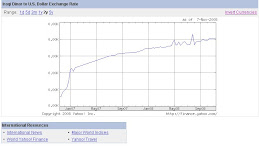
The volume of total demand for the dollar declined at the sessions of Iraqi Central Bank last week, to close at $ 655 million, compared with more than 796 million achieved in the previous week, while the exchange rate had stabilized at 1172 dinars to the dollar.

The Consultant at the Iraqi central bank, Mudhir Mohamed Saleh, said that the bank's policy in its auction for the sale of foreign currencies, "focus on stabilizing the exchange rate and strengthen the Iraqi dinar against the dollar, to face inflationary pressures which in our view that the exchange rate the most important". It is the policy of the central bank to raise the value of dinar gradually.

The average daily demand increased last week at 163.8 million dollars, which is higher than the highest rates achieved in the last period, as the third quarter of this year, the rate of 150 million dollars at each session.

The Central Bank of Iraq "reduced the interest rate to 14 percent rather than 15 percent".

( Iraq Directory )


Ulasan Singkat dari Paragraf Utama :

The Consultant at the Iraqi central bank, Mudhir Mohamed Saleh, said that the bank's policy in its auction for the sale of foreign currencies, "focus on stabilizing the exchange rate and strengthen the Iraqi dinar against the dollar, to face inflationary pressures which in our view that the exchange rate the most important". It is the policy of the central bank to raise the value of dinar gradually.

Kurang lebih kalau saya terjemahkan secara bebas adalah sebagai berikut :

Bank Sentral Iraq Meningkatkan Nilai Dinar Secara Bertahap

Konsultan Bank Sentral Iraq, Mudhir Mohamed Saleh, menyatakan bahwa kebijakan bank dalam lelangnya untuk Penjualan Valuta Asing, "Fokus dalam menstabilkan nilai tukar dan memperkuat Dinar Iraq terhadap dollar untuk menghadapi tekanan inflasi dimana menurut kami bahwa memperkuat nilai tukar Dinar Iraq adalah hal yang paling penting".

Adalah kebijakan Bank Sentral Iraq untuk meningkatkan nilai Dinar Iraq secara bertahap.

( Iraq Directory, 4 January 2009 )

Analisa dari saya :

Iraq sebagai negara Net Importir (negara yang memiliki ketergantungan yang sangat besar terhadap barang impor sehingga hampir seluruh kebutuhannya di impor).

Hampir semua barang yang di impor mereka bayar dengan mata uang dollar.

Kalau nilai mata uang dinar melemah terhadap dollar maka yang terjadi didalam negeri adalah inflasi / melambungnya harga barang dipasaran yang menyebabkan warga miskin & penderitaan semakin bertambah.

Dan kalau nilai mata uang dinar menguat terhadap dollar maka yang terjadi didalam negeri adalah tekanan inflasi akan berkurang.
Itulah mengapa Iraq menggenjot Ekspor minyaknya semaksimal mungkin.
Karena minyaknya dibayar dengan $.

Dan hampir satu2nya cara adalah dengan mengekspor minyak sebagai sumber devisa terbesar & membuat cadangan devisa mereka dalam bentuk US$ berlimpah.
Dengan demikian nilai US$ diharapkan akan melemah karena oversupply.

Namun demikian Pemerintahan Iraq tidak perlu khawatir dengan Cadangan Minyaknya yang terbukti no 3 terbesar di dunia. Itu yang membuat kita semua optimis bahwa Nilai Mata Uang Dinar Iraq akan bisa kembali seperti sedia kala atau minimal sama dengan nilai Dollar.

Yang kita harapkan agar semua itu bisa terjadi adalah Kedamaian sejati di iraq agar Iraq bisa membangun kembali bangsanya & yang paing penting Iraq dapat terus menjaga keamanan produksi minyaknya sehingga bisa terus menghasilkan dollar untuk memperkuat nilai mata uang yang mereka miliki.

Demikian analisa fundamental ekonomi Iraq secara Makro yang bisa saya sampaikan. Terima kasih.

Ibu Ita Arianto. (PH. 081330893103)
http://importir-dinar-iraq.blogspot.com
email: ummu_harits@yahoo.co.id



Rabu, Desember 24, 2008

IMF Menyatakan Iraq Sukses Dalam Semua Komitmennya

The IMF Confirms That Iraq Succeeded in All Its Commitments

The Finance Minister Bayan Jabr said the IMF Executive has finished its Board meeting and confirmed the success of Iraq in all its obligations under the supporting Convention.

Al-Zubaidi stated on Friday, the IMF decided to further reduction of twenty percent of the 30 billion dollars of Iraq's debt, and this news confirms the success of the Ministry of Finance in its plan to strengthen the Iraqi economy and resolve the issue of Iraq's foreign debt, which strengthens Economic stability in Iraq.

( Iraq Directory )

Jumat, Desember 19, 2008

Rencana Ekonomi Untuk Mengakhiri Perang Iraq

The Economic Plan to End the Iraq War

"Peace cannot be kept by force; it can only be achieved by understanding." - Albert Einstein

After the U.S. deposed Saddam Hussein, the Sunni Arabs lost control of the government, the military, and the economy. Majority rule put a Shiite-Kurd coalition in charge, relegating Sunni Arabs to a third-tier cultural, economic and political status. From the Sunni Arab point of view, the situation has only worsened since Iraqi Prime Minister Nuri al-Maliki, a strict Shiite sectarian, has further increased his power as a result of the "Surge."

Stability and a lessening of violence cannot be fostered under sectarian rule that ignores the economic and political aspirations of Sunni Arabs. Many Sunnis resist a regional solution because most of the developed sources of oil and gas revenue come from lands occupied by Shiites and Kurds, in the south and north.

What is too often overlooked is that significant sources of untapped oil and gas wealth, some 100 billion barrels of oil, according to the U.S. energy consultancy IHS Inc, exist in Iraq's Western Desert in the Sunni Arab province of al-Anbar. Extraction cost for the oil is estimated as low as $1.50/barrel, among the lowest in the world. A recent book, The Geology of Iraq, written by 16 geologists with firsthand knowledge of the geology of Iraq, is more conservative but still estimates substantial resources in the region. The book's chief author is the internationally known geologist, Dr. Saad Z. Jassim.

Both the Shiites in the south and the Kurds in the north have viable oil economies, a source of wealth which the Sunni Arabs currently lack. Development of oil and gas along with self rule and the prospect of significant revenue from their own oil and gas fields could well be the enticement for the majority of Sunni Arabs to cease their efforts to destabilize an Iraq in which they feel they no longer have a stake.

Such a plan could well receive the support of a majority of Kurds and Shiites, who are attempting to focus on their own prosperity and development after years of upheaval and violence. Indeed, a majority of Kurds, as well as the prominent Shiite group, the Islamic Supreme Council of Iraq (ISCI), have long supported a federal solution.

Success, however, requires an economic rationale. For Sunni Arabs the carrot is the development of oil and gas projects pursued under the ownership of the Sunni Arab Tribal Confederation, the principal Sunni political alliance in Iraq. Such a project also provides Sunni insurgent groups with a major incentive to cease violent attacks against oil and gas pipelines and other targets which are seen as only enriching Shiites and Kurds.

Oil wealth has transformed the quality of life for Kurds, who already enjoy de facto autonomy. They currently negotiate contracts with foreign firms who develop and operate their oil fields and are in negotiation with the Maliki government to sell their oil independently.

In the interest of promoting stability in the region, the U.S. and other nations must pressure Maliki to allow the Sunnis to benefit from revenues generated by such development. Start up funds could come from agencies such as the United Nations Capital Development Fund, or development could be opened to competitive bidding by international or Mideast oil companies.

The benefits of developing oil and gas for the benefit of Sunni Arabs in their own lands would be felt throughout the world. The symbolism of the Sunni Arab Tribal Confederation negotiating oil and gas contracts would stamp out a major piece of anti-American propaganda -- that the U.S. is only in Iraq to secure oil. In the short run, the fledgling Sunni Arab economy would be buoyed by investment and jobs. Transportation of the oil and gas -- which could easily tap into an extensive Turkish energy grid -- could increase energy supplies to Europe, which is suffering under Russia's energy chokehold.

Success of such a plan will only be achieved when Arab Sunnis witness that oil and gas revenues are benefiting the lives of the native Sunni population. Local development in Sunni lands would be a major blow to al-Qaeda in Iraq, whose best recruiting tool has been unemployment, dislocation, despair and resentment. There is less violence and a greater willingness to coexist among people who see the possibility of a better and more prosperous future.

( AINA )

Pembangunan Ekonomi di Iraq Th 2008 "Menggairahkan" Menurut Review Ekonomi Negara itu Oleh IMF

Economic development in Iraq in 2008 has been "encouraging" according to a review of the country's economy by the International Monetary Fund (IMF).

Improved security and a more stable political environment mean economic activity has "picked up" on the back of increased oil production and exports.

IMF deputy managing director Takatoshi Kato said the authorities had kept the economic programme "on track".

But the IMF warned that the sharp drop in the price of oil may stall progress.

Oil is now more than $100 a barrel cheaper than it was in July this year.

Continued efforts to stimulate economic growth depend "on continued improvements in the security situation and prioritisation in the use of lower oil revenues", Mr Kato said.

Oil revenue in 2009 would be much lower than in 2008, he added.

To compensate, the Iraqi government has already prepared measures to reduce spending next year.

Mr Kato also called on the government to "step up the pace of structural reforms," and to complete a regulatory framework for commercial banks.

"Further efforts are required to strengthen governance and fight corruption, in particular in the hydrocarbon sector," he added.

On Wednesday, Prime Minister Gordon Brown announced that improvements in security meant that UK troops would be withdrawn from Iraq by July 2009.

( BBC News )

Kamis, Desember 18, 2008

IMF Membatalkan 80% Hutang Luar Negeri Iraq

IMF Cancels 80% of Iraq’s Foreign Debts

The International Monetary Fund (IMF) has decided to write off 80 percent of Iraq’s foreign debts, the Central Bank of Iraq (CBI) said on Thursday.

During its meeting, dated December 17, the Executive Board of the International Monetary Fund completed the second review of Iraq’s economic performance under the Stand-By Arrangement (SBA), according to a CBI statement received by Aswat al-Iraq.

Describing economic developments in Iraq as encouraging, the board has decided to bring the total of cancelled debts to 80 percent, the statement noted.

The bank has expressed its great relief at the cancelation of over $100 billion U.S. dollars of Iraq’s external debts as a result of successful economic policies.

The Paris Club had written off 60 percent of Iraq’s foreign debts under the first SBA agreement, which expired in December 2007.

( Voices of Iraq )

Selasa, Desember 09, 2008

Iraq akan Membangun Terminal Minyak Lepas Pantai di Basra

Iraq plans to build a new offshore oil terminal in Basra, in addition to reviving the existing facilities, a former official says.

Former Iraqi Oil Minister, Thamir Ghadhban told MEED that the country is considering several options as part of an assessment program of the country's energy infrastructure in Basra province.

"We have a plan to rehabilitate the existing facilities and also expand," Ghadhban said. "By carrying out these plans, we will have more than enough capacity to serve the country."

Iraq tries to revive its oil and gas industry and build new oil refineries as well as improving its ageing infrastructure.

Iraq produces 2.5 million barrels of oil per day, most of which is exported.

The country has the world's third-largest known oil reserves, but war, regular sabotage attacks by insurgents and old infrastructure has created problems for the sector.

( Press TV )

Senin, Desember 08, 2008

Perusahaan Korsel Investasi 30M US$ di Ninewa

S. Korean Companies to Invest $30b. in Ninewa

The investment authority in Ninewa has signed contracts worth $30 billion U.S. dollars with South Korean companies to conduct investment projects in the province.

“The projects are in the fields of industry, agriculture, electricity, and oil,” Ninewa Governor Darid Kashmoula told Aswat al-Iraq.

“Contacts are currently underway between the authority and Croatian companies to establish services compounds at the border outlet in Rabia, western Mosul,” he added.

Mosul, the capital city of Ninewa, lies 405 km north of Baghdad.

The original city of Mosul stands on the west bank of the Tigris River, opposite the ancient biblical city of Nineveh on the east bank, but the metropolitan area has now grown to encompass substantial areas on both banks, with five bridges linking the two sides.

Despite having an amount of Kurdish population, it does not form part of the area controlled by the Kurdistan Regional Government (KRG).

( Voices of Iraq )

Sabtu, Desember 06, 2008

Penyulingan Minyak Senilai 4 Milyar $ Akan Dibuat di Missan

$4B Oil Refinery to Be Set Up in Missan

The Iraqi Ministry of Oil is planning to build a new oil refinery in Missan province at a cost of $4 million U.S. dollars, Missan’s mayor said on Wednesday.

“During the coming few days, the Ministry of Oil will sign a contract for the establishment of a refinery with a capacity of 150,000 barrel per day (bpd),” Adel Mahodar told Aswat al-Iraq, noting that the completion period is 18 months.

“The project will be referred to the cabinet for approval given the high cost of the project,” the mayor explained.

Missan is a Shiite province. Its capital city is al-Amara. Sitting on the Tigris River, Amara lies 390 km south of Baghdad. Missan, in the east of the country, bordering Iran, is home to many marsh Arabs.

( Voices of Iraq )

Penyulingan Minyak Senilai 4 Milyar $ Akan Dibuat di Missan

$4B Oil Refinery to Be Set Up in Missan

The Iraqi Ministry of Oil is planning to build a new oil refinery in Missan province at a cost of $4 million U.S. dollars, Missan’s mayor said on Wednesday.

“During the coming few days, the Ministry of Oil will sign a contract for the establishment of a refinery with a capacity of 150,000 barrel per day (bpd),” Adel Mahodar told Aswat al-Iraq, noting that the completion period is 18 months.

“The project will be referred to the cabinet for approval given the high cost of the project,” the mayor explained.

Missan is a Shiite province. Its capital city is al-Amara. Sitting on the Tigris River, Amara lies 390 km south of Baghdad. Missan, in the east of the country, bordering Iran, is home to many marsh Arabs.

( Voices of Iraq )

Jumat, Desember 05, 2008

Japan Nipon Oil Membicarakan Penyulingan Minyak Iraq 5-10 M US$

Japan Nippon Oil in Talks on $5-10 Bln Iraq Refinery

Japan's Nippon Oil Exploration is in talks with the Iraqi government on the construction of an oil refinery worth $5-10 billion and investment in oil exploration for the same amount, a company official said on Friday.

"We submitted a proposal and still discussion is ongoing," Ryunosuke Onogi, an executive and general manager at the company, which is a member of the Nippon Oil (5001.T: Quote, Profile, Research, Stock Buzz) group, told Reuters at an energy conference in Baghdad.

"The construction of the refinery (would cost) about $5-10 billion. Probably the size of the (oil exploration) investment is the same upstream and downstream," Onogi said.

Iraq's cabinet last month approved the construction of two new oil refineries, with a total capacity of 300,000 barrels per day (bpd). Iraq is also planning to build two other refineries, with a total capacity of 450,000 bpd. The refineries' output would be aimed at both the domestic and international markets.

Existing refineries have been crippled by years of sanctions, under-investment and insurgent attacks.

( Reuters )

Minggu, November 30, 2008

Iraq Menyetujui Pembangunan Dua Penyulingan Minyak Baru

Iraq OKs Construction of Two New Oil Refineries

By Wisam Mohammed

Iraq's cabinet has approved the construction of two new oil refineries with a total capacity of 300,000 barrels per day, Iraq's Oil Ministry spokesman said on Sunday.

One of the refineries is to be located in northern Kirkuk province and the other in southern Maysan province, spokesman Asim Jihad told Reuters, adding that both had a capacity of 150,000 bpd.

A company has already been chosen to build the Kirkuk refinery, but Jihad declined to name the firm. A company has not yet been chosen to build the Maysan plant.

Firms had also not been chosen for two previously announced refineries -- one 300,000 bpd plant in Nassiriya province and the other a 150,000 bpd plant in Kerbala, both in Iraq's south.

All are open to foreign investment in partnership with the Iraqi government, except the Nassiriya refinery which is open to full foreign investment.

"These steps will satisfy our oil product needs," Jihad said, adding that some of the refineries' output are earmarked for export to neighboring countries.

Iraq has a severe shortage of motor fuel, despite sitting on the world's third-largest proven reserves of oil. Existing refineries have suffered from years of sanctions, under-investment and insurgent attacks.

( Reuters )

Jumat, November 28, 2008

Iraq Mengekspor 53 juta Barrel Dalam Sebulan

Iraq Had Exported 53 Million Barrels Within a Month

The Oil Ministry's spokesman Asim Jihad, declared in an interview with Al-Hayat paper, that Iraqi oil exports amounted to 52.8 million barrels a total value of 3.11 billion U.S. dollars in (October) the past. The average selling price of crude oil of 58.9 dollars per barrel.

He added that the amount of crude oil exports from Basra (via the ports of Basra and Khor al-Amaya located on the Arabian Gulf), amounted to 42.9 million barrels, worth 2.5 billion dollars, in quantities of oil exports from Kirkuk (via the Turkish port of Ceyhan on the Mediterranean) 9.9 million barrels, worth 603 Million, were distributed among 22 international companies.

The member of « Oil and Gas Commission » in Parliament Abdul Hadi al-Hassani, clarified that the emigration of qualified staff which Iraq suffered lately led to the deterioration of the oil sector and the low efficiency of the technical work. He attributed it resorts to contracts with international oil companies to the need for advanced technology in this sector and for much better investment.

And about the performance of the Iraqi oil ministry, He said that each Ministry has its parameters to set frameworks and work strategies, the good governance and how to use the proceeds to the development of financial work. He added: «the investment budget that devoted to the oil sector is still under the required level, we need an investment budget not operational». He stated that the reasons for the decline of the sector's performance due to hidden unemployment, and bureaucratic work in opening credits, which are an impediment to the government oil companies, and the oil port unprepared for export and the pipelines are obsolete. He called for «interest in addressing these imbalances in order to attract international companies to invest in Iraq».

The «Reuters» agency quoted to the Turkish (Anatolia )semi-official agency, that the flow of Iraqi oil through Kirkuk - Ceyhan pipeline to Turkey resumed yesterday, after extinguishing a fire broke out because of an attack by rebels from the PKKA Party in the province of Mardin in southeastern Turkey.

( Iraq Directory )

Selasa, November 25, 2008

Pendapatan Minyak pada Bulan Oktober Melebihi 3 Milliar US Dollar

Oil Revenues in October Exceed $3B

Iraq’s oil revenues in October 2008 have exceeded $3 billion, an official spokesperson for the Ministry of Oil said on Monday.

“Last month, the ministry exported 58.902 million barrels of oil through its northern and southern outlets,” Aasem Jihad told Aswat al-Iraq.

A total of 22 international companies from the United States, Asia, Europe, Jordan and Morocco were the importers, he added.

( Voices of Iraq )

Selasa, November 18, 2008

Obama Bersumpah Untuk Keluar Dari Iraq

US President-elect is determined to crush Al-Qaeda in Afghanistan, shut down Guantanamo Bay camp.


President-elect Barack Obama vowed to pull troops out of Iraq, crush Al-Qaeda in Afghanistan and shut down the Guantanamo Bay camp as part of a dramatic foreign policy break with George W. Bush.

Repairing the stricken US economy will be priority number one, even at the cost of still-bigger budget deficits, Obama said in his first major post-election interview broadcast on CBS program "60 Minutes" late Sunday.

Following his election triumph of November 4, Obama said at least one Republican would be in his cabinet and confirmed that he had met former Democratic primary rival Hillary Clinton last week.

But the president-elect refused to comment on speculation linking the former first lady to the job of secretary of state.

The man who will be the first black US president is accelerating his transition to inauguration day, resigning his Senate seat Sunday and appointing three more top aides to serve in his White House once he succeeds Bush.

As soon as that happens on January 20, Obama said, "I will call in the Joint Chiefs of Staff, my national security apparatus, and we will start executing a plan that draws down our troops" from Iraq.

"Particularly in light of the problems that we're having in Afghanistan, which has continued to worsen. We've got to shore up those efforts," Obama said in the interview, which was taped Friday.

On the campaign trail, Obama vowed to pull one or two combat brigades out of Iraq every month until after 16 months, only a residual security force of unspecified size remains. Some of those brigades would head to Afghanistan.

He told CBS that "it is a top priority for us to stamp out Al-Qaeda once and for all" and that killing or capturing the group's mastermind Osama bin Laden was "critical" to US security.

Obama pledged to tackle controversial offshoots of Bush's "war on terror" -- the US military's internment camp at Guantanamo Bay, Cuba, and harsh interrogations of captured terror suspects.

"I have said repeatedly that I intend to close Guantanamo, and I will follow through on that," the president-elect said.

"I have said repeatedly that America doesn't torture. And I'm going to make sure that we don't torture. Those are part and parcel of an effort to regain America's moral stature in the world," Obama added.

But he did not elaborate on where the Guantanamo prisoners would be taken, whether they would be transferred to civilian custody in the United States itself, put on trial, or released.

A command to redeploy troops out of Iraq or shut down Guantanamo could be done in short order under Obama's presidential prerogatives, and he is expected to reverse a slew of other contentious "executive orders" signed by Bush.

Obama said that in Congress, his first legislative priority was getting another stimulus package passed to prop up the enfeebled economy, if Democrats in the outgoing legislature fail to overcome Republican opposition.

As already shown in excerpts released by CBS, Obama said it would be a "disaster" for the government to stand by and let the cash-strapped General Motors and the auto industry in general collapse.

In line with the outcome of a summit Saturday of the world's 20 biggest economies, the president-elect said forging new regulation of the financial markets was essential to restoring the trust of consumers.

Obama appeared unconcerned about the red ink blotting the US government's finances, arguing economists from left and right agreed that "we have to do whatever it takes to get this economy moving again."

"And that we shouldn't worry about the deficit next year or even the year after. That short term, the most important thing is that we avoid a deepening recession," he said.

Joined by his wife Michelle in the interview, Obama said their two young daughters would get their promised dog, and expressed hope that Michelle's mother Marian Robinson would move in with them at their new residence.

Obama, a gifted writer who has authored two best-selling memoirs, turned wistful as he anticipated life in the White House fishbowl.

"That's something that I don't think I'll ever get used to. I mean, the loss of anonymity," he said. "And this is not a complaint, this is part of what you sign up for."

( Middle East Online )

Minggu, November 16, 2008

Penyulingan Minyak 10000 Barrel Per Hari dibuka di Dewaniya

Refinery Produces 10 000 B/d Opened in Dewaniya

Oil minister, Hussein Shehristani, opened Dewaniya oil refinery that its primary production capacity mounts 10 thousand b/d to add two units that produce 20 thousand b/d at near future.

At the same time, Finance minister, Baqer Jabr, declared that Iraq seeks multiplication to its oil exports by triple within 10 years through investing $ 2 billion at this sector in the next year and this goal requires holding negotiations with foreign companies to develop the oil infrastructure.

( Al-Sabaah )

Refinery Produces 10 000 B/d Opened in Dewaniya

Oil minister, Hussein Shehristani, opened Dewaniya oil refinery that its primary production capacity mounts 10 thousand b/d to add two units that produce 20 thousand b/d at near future.

At the same time, Finance minister, Baqer Jabr, declared that Iraq seeks multiplication to its oil exports by triple within 10 years through investing $ 2 billion at this sector in the next year and this goal requires holding negotiations with foreign companies to develop the oil infrastructure.

( Al-Sabaah )

Sabtu, November 15, 2008

Iraq Opens New Oil Refinery to Meet Growing Demand

Iraq has opened a new oil refinery in the southern province of Qadisiyah to meet increasing demand.

The refinery's senior engineer, Hussam Ali Jalmod, says the refinery opened Friday and will start producing in the next few days.

He says the plant's initial capacity is 10,000 barrels per day. It plans to double that by mid-2009.

Iraq has the world's third-largest oil reserves, totaling 115 billion barrels. But it suffers acute refinery shortages following years of U.N. sanctions and war.

The country currently refines just over 400,000 barrels per day at three main refineries and handful of smaller ones.

Qadisiyah province is 80 miles, or 130 kilometers, south of Baghdad.

( Associated Press )

Jumat, November 14, 2008

$2 Billion Iraq Plan to Boost Crude Production

Iraq aims to triple oil exports to six million barrels per day (bpd) in 10 years, earmarking $2 billion to start increasing capacity. "We are allocating about $2bn to the Oil Ministry in the next year's budget to start increasing capacity in this sector," Finance Minister Baqer Jabr Solagh said.

"From my view, we need to increase our exports at least to what they were in the 1980s, when we exported 3.4m barrels a day," he said.

Current production stands at some 2.4m bpd, of which 2m are exported.

Solagh pointed out that the oil industry's infrastructure and technology are woefully inadequate, however, and that the aid of foreign companies will be necessary if it is to achieve its goals.

"My view is that we have to deal with international companies, Europeans and Americans, and the others, because our technology... is still old, maybe dating back to the 1970s, as well as the equipment," he said.

"For that I think Iraq needs the help of the international oil companies to enter Iraq and do investment" either through revenue-sharing deals, or simple payment for service.

One such arrangement was concluded on Monday, when Iraq and China National Petroleum Corporation (CNPC) signed a $3bn deal to develop Al Ahdab oilfield in Wasit province for 23 years.

Production is expected to reach 25,000 bpd in the first three years and expand to 115,000 bpd in six years.

While output from the field will be exported, a portion of it will be used to fuel power generation stations nearby to alleviate electricity shortages, it added.

China won the rights to Al Ahdab in a 1997 deal then valued at $700 million, but activities were suspended because of UN sanctions and subsequent security issues following the US-led invasion in 2003.

Baghdad said earlier it had managed to change the previous joint venture contract into a mere service agreement, under which CNPC would charge a service fee of $6 a barrel. The fee will decrease eventually to $3.

In September, Royal Dutch Shell signed a gas joint venture estimated to be worth $4bn, becoming the first Western major to enter Iraq through a deal with Baghdad after nearly four decades.

Former dictator Saddam Hussein threw out foreign oil companies after he nationalised the sector in 1972.

Since his execution in 2006, a number of foreign majors had signed contracts with the government of the Kurdish region in the north, but none with the central government.

( Gulf Daily News )

CNPC, Iraq Sign 23-Year Service Agreement to Develop Al-Ahdab Field

On November 10, CNPC President Jiang Jiemin and Dr. Hussain Al-Shahristani, Iraqi Minister of Oil, signed a 23-year service agreement on the development of the Al-Ahdab Oilfield in Baghdad. Another Chinese partner, Zhenhua Oil, also signed at the contract copy. The contract is among Iraq's first batch of joint-venture oil projects since the US-led invasion in 2003, and is significant to expanding strategic energy cooperation between the two countries.

The Al-Ahdab Oilfield is located 180 kilometers southwest to Baghdad, with a structural area of 200 square kilometers. CNPC will use advanced and applicable technologies to increase the oilfield's production capacity to 25,000 barrels per day within three years, and to 115,000 barrels per day within six years.

( CNPC )

Shell Still Happy to Invest in Oil at $50/bbl

Royal Dutch Shell Chief Executive Jeroen van der Veer said on Thursday investing in oil projects could still be attractive with the price of $50 a barrel if taxes and royalties on oil production are not too high.

Executives and officials of oil producing countries have previously said oil prices of about $80 a barrel were needed to justify investment in new projects.

Asked if the $50 a barrel would justify oil production, Veer told reporters in Istanbul: "Yes I can produce, provided I do not have too high taxation and royalties ... That is in the hands of the government."

Veer said the Anglo-Dutch oil giant was "very much interested" in Iraqi oil contracts, which he projected would be distributed in 2009 and Shell was in talks with a number of companies about a possible consortium.

"We will make the bidding sometime in 2009 when we expect the contract to be given. We are talking for a consortium with an oil company and then bid maybe some weeks before the bidding starts." he said.

"After the contracts, we will have additional opportunities there."

However, some analysts and oil executives said the government's hopes of having deals by the summer were overly ambitious.

Shell signed an initial multi-billion dollar agreement in October with Iraq to capture gas that otherwise would be burnt off during production of oil.

Veer said their gas deal with Iraq depended on the safety of Shell workers there. "If staff safety is not guaranteed, we will withdraw our staff."

He said current financial distress will add more complexity to pipeline projects, already complicated by governments and the need for viable throughput.

"We do not invest in a pipeline project unless our hydrocarbon flows in it," he said in response to a question about whether Shell would take part in a Turco-Italian oil pipeline deal to pump its Kazakh and Caspian oil via the Black Sea and Turkey to the Mediterranean. "Let us study it now."

Shell said in October it would delay a decision on expanding its Canadian oil sands project as rising costs and falling crude prices raise questions about the profitability of the industry.

Veer said oil sand projects were "at the moment the most expensive" source of oil supply under the present level of oil prices.

( Xinhua News Agency )

MULAI HARI JUM'AT TANGGAL 14 NOV 2008, KAMI MEMBUKA LAYANAN PEMBELIAN DINAR IRAQ

Dengan adanya permintaan dari Investor Dinar Iraq di Indonesia yang menginginkan adanya Fasilitas Layanan Pembelian Dinar Iraq dari kami, maka Situs kami berusaha untuk memfasilitasi hal ini dengan mempertemukan antara Penjual & Pembeli Dinar Iraq di Indonesia. Semoga layanan ini dapat membantu rekan - rekan Investor.

Syarat – syarat Lembaran Dinar Iraq yang kami terima adalah :

  1. Asli (Lolos dari Money Detector Device / Scanner Uang Kami)

  2. No Seri Urut

  3. Baru & belum pernah digunakan untuk transaksi jual beli (New Uncirculated)

  4. Tidak terlipat

  5. Kami mengutamakan Dinar Iraq yang sebelumnya beli dari kami

Info dan penawaran lebih lanjut silahkan hubungi saya Ibu Ita Arianto di Ph. 081330893103.

Semoga layanan ini bisa memperkuat kerjasama dan kepercayaan di antara Seluruh Investor Dinar Iraq di Indonesia.

Terima kasih.